Team Shelters, Explained: How to Size, Anchor, Finish and Budget for a Sideline Shelter
By PitchEquipment Team
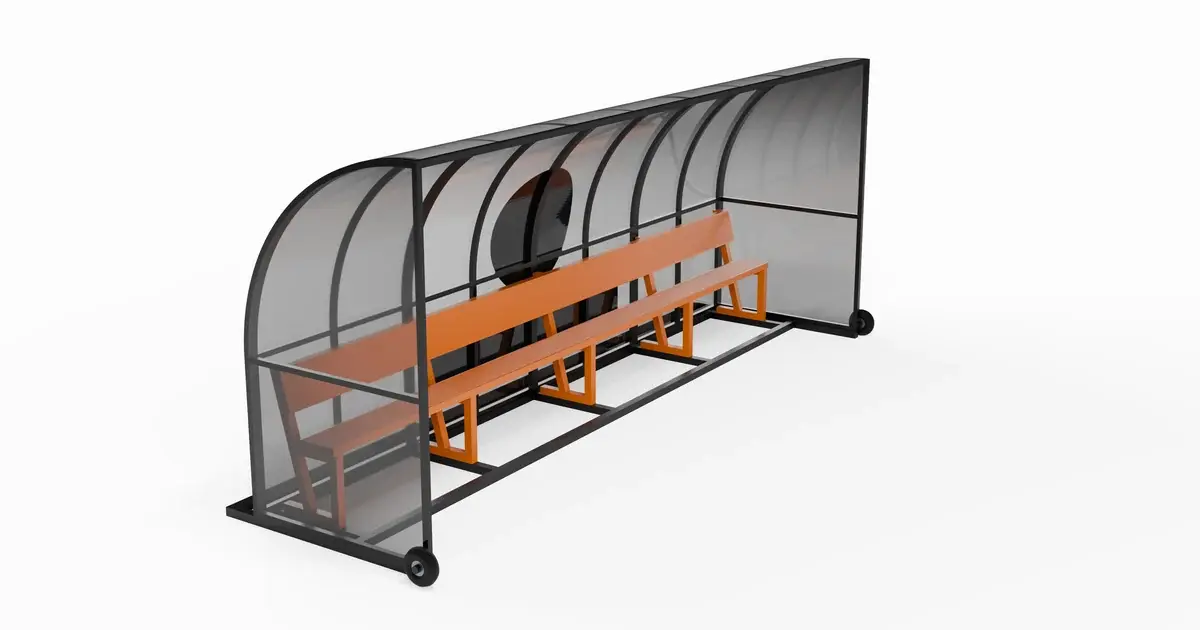
A team shelter is a covered, enclosed bench for players and staff on the sideline, out of the sun, the rain, and the wind. Soccer, lacrosse, field hockey, baseball, and softball programs use them when the bench is open to the weather. Euro Series team shelters are built in one shop in Shelby, North Carolina. Five lengths run from the 8-foot ES-8 to the 24-foot ES-24. Every size is the same shelter — same frame, same panels, same bench. Only the length changes.
What is a team shelter, and how is it different from a dugout?
A team shelter is the covered bench on the sideline. The same unit is also called a sideline shelter or a player shelter, and baseball and softball programs call it a portable dugout.
Readers outfitting that baseball and softball bench should continue on the baseball page. The rest of this guide is the sideline shelter: how long a unit to buy, whether you need one or two, how it stays put, which finish to pick, and what the mill-finish price is.
How many players fit in a team shelter?
Seat count follows the length. Plan for the full substitute bench plus 2–3 coaching staff.
| Model | Length | Seats |
|---|---|---|
| ES-8 | 8 feet | 5 players |
| ES-12 | 12 feet | 8 players |
| ES-16 | 16 feet | 10 players |
| ES-20 | 20 feet | 13 players |
| ES-24 | 24 feet | 16 players |
College soccer usually goes with the ES-16 or the ES-20. Count the people who sit and stand in your own bench area, including the two or three staff, and match that count to the length. The table is seating capacity. It is not a roster chart for every sport or every level.
One shelter or two?
One shelter covers a single sideline. Two cover home and visitor.
Baseball and softball programs generally run the ES-16 or the ES-20, ordered in pairs for home and visitor. On mill finish, before freight, two ES-16s are $25,446, two ES-20s are $30,090, and two ES-24s are $33,928. Powder coat and custom graphics change those totals. They are priced by size in the configurator, and this guide does not estimate them.
Portable or anchored?
Both. Integrated wheels move the shelter on and off the field, and ground anchors are included for holding it in place.
The wheels are 8.5-inch rubber. Roll the shelter into position for games and back to storage after. Most schools move them off the infield for field maintenance and tournaments. When you mount the shelter on concrete, you still need footings or a pad. If a concrete pad does not exist and is not planned, you can use your own sandbags or other temporary securement. Footing and pad preparation is not included in PitchEquipment pricing. The ground anchors ship with the unit. The concrete, when that is how you mount it, is yours to prepare.
What are team shelters made of?
An aluminum frame, tinted polycarbonate panels, and an aluminum bench with a backrest. The shelter is 6 feet 10 inches high and 4 feet 8 inches deep.
Every size is that same shelter. The frame, the panels, and the bench do not change from the shortest unit to the longest. Only the length changes. The wheels are 8.5-inch rubber, and the ground anchors are part of every unit. The frame is mill-finish aluminum unless you add powder coat.
Mill finish or powder coat?
Mill finish is standard. Powder coat is an add-on, priced by size.
On a powder-coated shelter there is no upcharge for the color itself. Send a RAL code or a Pantone reference and the shop matches it, which is how school colors get onto the frame. The bench is a separate finish: it is powder coated as standard in RAL 7004 Signal Gray, and the bench color can be changed. The frame stays mill finish unless powder coat is added. Optional custom graphics — club artwork printed and applied to the outside of the back panel, including shop pre-assembly — are priced by size in the configurator. Build the shelter there to see the powder-coat and graphics lines. They are not estimated on this page.
How long does a team shelter last?
Expected service life is 15+ years. That is not the warranty term. The warranty is 3 years.
An ES-8 at $9,895 works out to about $660/year over that 15-year expected life. That figure is expected-life math, not the warranty. Fabric shelters cost $3,000–$8,000 and are replaced every 3–5 years. Set that replacement cycle next to the 15+ year expected life — still not the 3-year warranty — on the soccer page.
When a panel has to be replaced, panels are sold singly and fit every Euro Series size. They arrive pre-drilled, with the fasteners included. A lower rear panel is $70, an upper rear panel is $249, and an end panel is $325. Order them from the replacement parts page.
Shelters used by programs including Alabama, Penn State, and Texas A&M, and on the sideline at the NCAA Division I Men's Soccer College Cup.
How do soccer, lacrosse, field hockey, and baseball use a team shelter?
Soccer. The shelter is the covered bench on the touchline for players and staff. The soccer page is the sport home for that bench.
Lacrosse. The same shelter sits on the lacrosse sideline. The lacrosse page covers that sideline.
Field hockey. The bench area runs from the substitution area to the 23-meter line, and people stay behind a restraining line at least 5 yards from the sideline (no less than 3 meters if 5 yards isn't available). That layout is from the 2026-27 NCAA Field Hockey Rules Modifications, rule 6.10. Check your rulebook and your conference for the bench-area layout on your field before you place anything. The field hockey page covers the equipment for that sport.
Baseball and softball. Programs generally run the ES-16 or the ES-20, and they order them in pairs. The baseball and softball page is where that equipment is laid out.
What does a team shelter cost?
Mill-finish base prices are $9,895 for the ES-8, $11,338 for the ES-12, $12,723 for the ES-16, $15,045 for the ES-20, and $16,964 for the ES-24.
Every unit includes transport wheels, ground anchors, and the 3-year warranty. Freight is not included. It is quoted by destination. Installation is not included: you self-install, or PitchEquipment can recommend local contractors. Site work — any pad or footing preparation — is not included. Standard lead time is 4–6 weeks. Shelters ship nationwide and to Canada.
Prices are posted on the team shelters page, where the configurator prices size, finish, and graphics as you build, and on the pricing page. Posted prices run 15–20% below comparable national-brand products. PitchEquipment has built in one shop in Shelby, North Carolina, since 1994 — 32 years — and we ship to all 50 states and Canada. Resellers can start with the dealer program. The rest of the line includes backstops and press boxes.
Frequently asked questions
Do team shelters ship?
Yes. Shelters ship nationwide and to Canada. Freight is quoted by destination and is not included in the price.
How long does delivery take?
Standard lead time is 4–6 weeks.
Is installation included?
No. You self-install, or PitchEquipment can recommend local contractors. Site work, including any pad or footing preparation, is not included. Ground anchors are included.
Can I get my school colors?
Mill finish is standard. Powder coat is an add-on priced by size, and the color itself is no extra charge. Send a RAL code or a Pantone reference and the shop matches it. The bench is powder coated as standard in RAL 7004 Signal Gray, and the bench color can be changed.
Can I replace a panel?
Yes. Replacement panels are sold singly, fit every Euro Series size, and come pre-drilled with fasteners included. A lower rear panel is $70, an upper rear panel is $249, and an end panel is $325.
Build yours and see the price on the team shelters page. Questions go to the shop, to 866-482-0221, or to sales@pitchequipment.com.