What Is a Batter's Eye? The Dark Backdrop Explained
By PitchEquipment Team
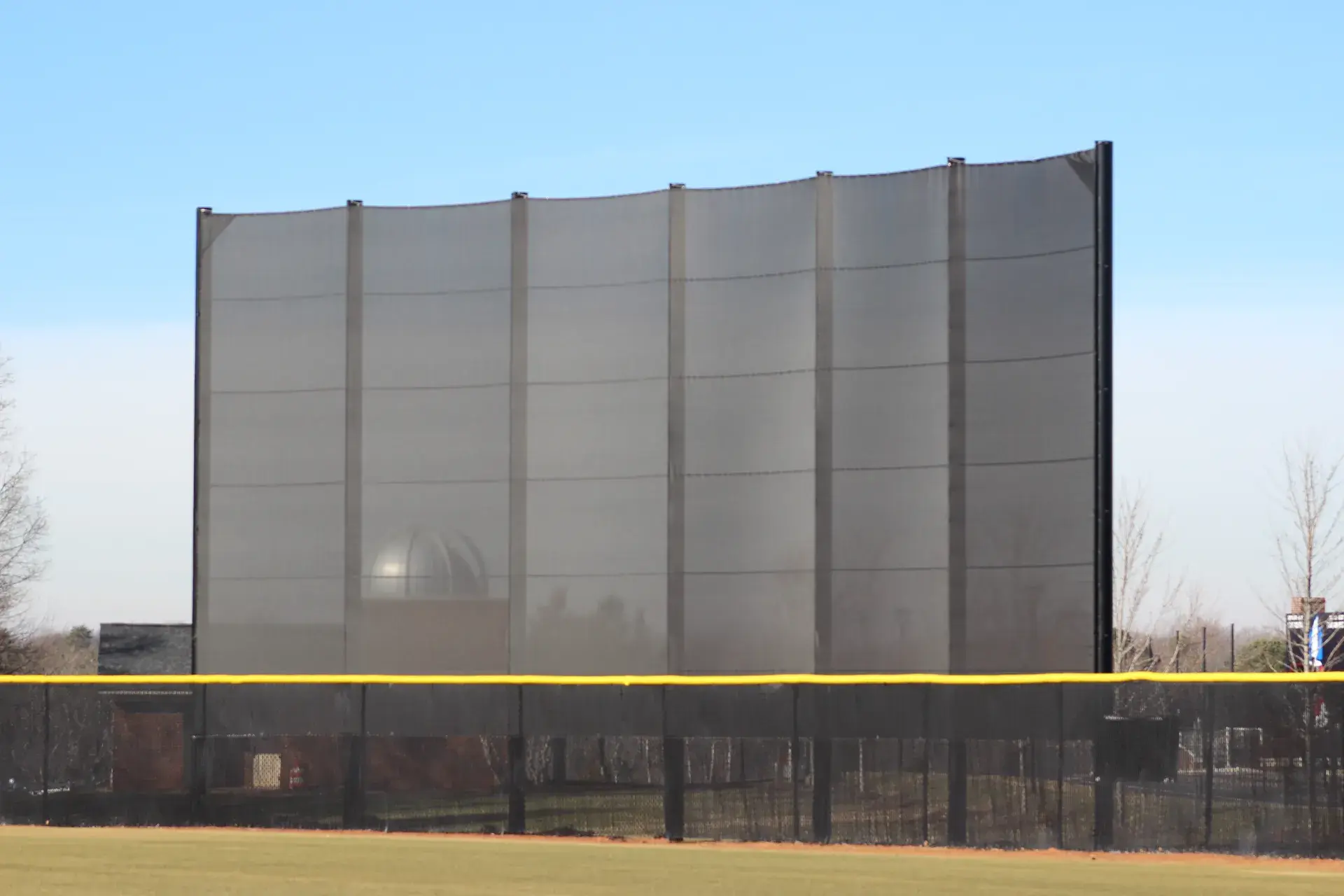
Watch any baseball broadcast and you'll see it without noticing it: the dark, uncluttered wall or screen in dead center field, directly behind the pitcher from the hitter's point of view. That's the batter's eye (often written "batters eye," and sometimes called a hitter's background). Its job is simple — give the batter a clean, dark background so a white ball traveling 80-95+ mph is visible from the instant it leaves the pitcher's hand.
A pitch takes roughly four-tenths of a second to reach the plate. Hitters make their swing decision in the first half of that window, which means the first few feet of ball flight are everything. Against a background of moving fans, parked cars, sky glare, or waving trees, the ball effectively disappears for a fraction of that window — and at game speeds, that fraction is the difference between squaring a ball up and getting handcuffed. It's a safety issue as much as a performance one: a hitter who never picks up an inside fastball can't get out of its way.
Is a batter's eye required?
There's no single rulebook dimension that every field must meet, but at competitive levels an effective hitter's background is treated as standard equipment rather than an option. Every MLB stadium provides one. College and high school governing bodies expect an unobstructed, non-distracting background behind the pitcher, and umpires and conferences flag fields where hitters lose the ball in the background.
In practice, the "requirement" shows up three ways: player safety expectations, conference and tournament hosting standards, and simple competitiveness — recruits and visiting coaches notice a field where hitters are guessing. If your program hosts playoff baseball or wants to, a proper batter's eye is one of the first facility items evaluators look at.
How big is a batter's eye?
The right size depends on the geometry of your field: the distance from home plate to the center field fence, the fence height, and what sits behind it. The batter's eye has to fill the hitter's sight cone around the pitcher's release point — taller and wider than you'd guess, because that cone expands with distance.
- Width: most systems run 30 to 60 feet wide, with 40-50 feet typical for college fields.
- Height: 16 to 32 feet of visual backdrop, usually extending well above the fence line.
- Position: centered on the home plate-to-pitcher sight line in dead center field.
A common mistake on school fields is sizing the batter's eye to the fence rather than to the sight line — a backdrop that stops at an 8-foot fence does nothing for a pitch released 6 feet off the ground and viewed from a crouch 60 feet away. This is why serious installations start with a field assessment rather than a size chart.
Why are they dark green or black?
Contrast. A white baseball reads best against a dark, flat, non-reflective surface, and dark green and black consistently test best in daylight and under lights. Glossy surfaces are avoided because specular glare can be worse than no backdrop at all. Some facilities match the batter's eye to program colors, but the working area behind the pitcher stays dark for a reason — this is one place where branding takes a back seat to function.
What are batter's eyes made of?
Professional and amateur parks solve the same problem with different materials:
- Mesh windscreen panels — vinyl-coated polyester stretched on a frame. Wind passes through, which reduces structural load and cost. The standard choice for high school budgets.
- Perforated steel panels — powder-coated steel with fine perforations. Superior contrast and durability with a pro-facility look; the common choice for NCAA and professional installations.
- Living backdrops — some MLB parks landscape the job: Dodger Stadium's center field backdrop is planted trees, and Coors Field grows evergreens beyond the fence.
- Blacked-out seating — where center field bleachers exist, parks tarp or paint them dark and keep them empty. Yankee Stadium's famous "black" seats worked this way for decades.
What does a batter's eye cost?
For a fabricated-and-installed system, budget in these ranges:
- High school fields: $40,000-$55,000 — mesh panel systems, 30-40 feet wide, installed on concrete foundations.
- College facilities: $55,000-$80,000 — larger mesh or perforated steel systems with heavier structural support.
- Division I / professional: $80,000-$100,000+ — full perforated steel at 50-60+ feet wide.
Size and material drive most of the cost; installation, engineering, and foundations make up the rest. Retrofitting panels to an existing fence is meaningfully cheaper than building a standalone structure. For the full breakdown — including what drives the price up or down — see our batter's eye design and installation page.
Batter's eye vs. backstop: not the same thing
The two get confused because both are "screens on a baseball field." A backstop sits behind home plate and protects spectators from foul balls and wild pitches. The batter's eye sits behind center field and exists purely for pitch visibility. Most field upgrade projects eventually involve both, but they're engineered for completely different loads and purposes.
Getting one built
A batter's eye is a permanent structural installation — wind load engineering, sometimes permitting, concrete foundations, and a crew to put it up. We design, fabricate, and install custom batter's eye systems from our shop in North Carolina, with full-service installation across the Southeast US, for schools, colleges, parks departments, and the contractors who build their facilities.
Curious what your field needs? Send us your center field dimensions and a few photos and we'll recommend a size and budget — request a batter's eye quote or start with our complete guide to sizing and pricing.